|
TOURIST
SPOTS AROUND MUMBAI
MAHABALESHWAR This
popular hill resort, in the state of Maharashtra, was once the
summer capital of the Bombay Presidency, during the days of the
British. Situated at an altitude of 1372 meters, Mahabaleshwar
has splendid panoramic views of the scenic valley, and of the
sea, which is quite visible on clear days. Like other hill stations,
Mahabaleshwar closes during the monsoon season. During this period,
from mid-June to mid-September, the local buildings are covered
with kulum grass to prevent any damage from the torrential rains.
During this period, the region receives about 6 mts. of rain!! What
to see Elphinstone
Point, Babington Point, Kate's Point, Bombay Point are some of
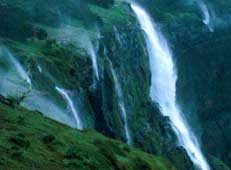
the famous lookout points. There are also some beautiful waterfalls,
a short distance away, that are worth a visit, like Chinaman's
(2.5 km), Dhobi (3 km), and Lingamala (6 km). Arthur's Seat, 12
km from Mahabaleshwar, looks out over a tremendous drop of 600
meters, to the coastal strip of Konkan. Also a site to be visited,
is the historic Pratapgad Fort (24 km), built in 1656, by Shivaji
to control the rebellious Satraps of the surrounding Javali Basin.
Legend has it that Shivaji was blessed with a shining sword at
the temple of Goddess Bhawani here. It was the site of the famous
battle between the Maratha chieftain Chhatrapati Shivaji and Afzal
Khan, the commander of the Bijapur Sultanate. A major attraction
in Mahabaleshwar is the Venna Lake, which has good fishing and
boating facilities. Pratapgarh
Fort Which
is 24 kms, away is a place worth visiting. It was built by Shivaji
in 1656. It was built to control the rebellious Satraps of the
surrounding Javali Basin. Legend has it that Shivaji was blessed
with a shining sword at the temple of Goddess Bhawani here. It
was the site of the famous battle between the Maratha chieftain
Chhatrapati Shivaji and Afzal Khan, the commander of the Bijapur
Sultanate. Top
PANCHGANI 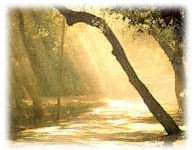 Panchgani derives its name from the five hills around it. At an altitude
of 1334 m, it is just 38 m below Mahabaleshwar. These 38 m translate
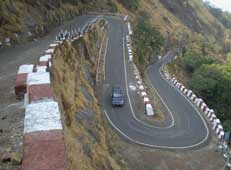
themselves into a breathtaking 18 km approach, that swoops around
and bends with abandon, offering splendid views of the river Krishna
on one side, and the coastal plains, on the other. Panchgani derives its name from the five hills around it. At an altitude
of 1334 m, it is just 38 m below Mahabaleshwar. These 38 m translate
themselves into a breathtaking 18 km approach, that swoops around
and bends with abandon, offering splendid views of the river Krishna
on one side, and the coastal plains, on the other.
Panchgani is the quintessential hill station. It can be seen in
the architecture of the old British buildings, the Parsi houses,
and the boarding schools that have been around for a century or
more. Amble along the walkways, thickly canopied by lush trees
and vegetation, and delight in the secrets you stumble upon. The
river Krishna snakes through tiny hamlets, farms and ravines.
Select a horse from one of the numerous stables and canter along
unchartered routes through hidden lovers' routes, to the caves
and the Kamalgad fort. Or while away your time at the bazaar.
Taxis are available, but bicycles and horses are recommended for
travelling long distances.
Top
ELEPHANTA CAVES 10
km north east of Apollo Bunder, lies the island of Elephanta,
the glorious abode of Lord Shiva. The island is famous for its
great cave shrine, excavated in the sixth century, dating back
to the period, when the island was known as Gharapuri, the Fortress
City. With the arrival of the Portuguese, the island was renamed
Elephanta, after the huge carved elephant, they found at the place
where they landed. 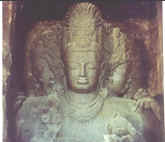 The cave temple, which is the pride of Elephanta, sprawled
over an area of approximately 5000 square
metres, is reached by climbing a flight of more than 100 steps,
to the top of a hill. Inside the temple, is a large pillared hall
with rows of columns, that appear to hold up the roof of the cave.
Cross beams complete the illusion of a ceiling. One's attention
is immediately drawn to the series of marvellous sculptured panels,
nine in all, which are set like tableaux on the walls. Little
is known about the architects and sculptors, who worked on this
gem of ancient architecture. What is almost tangible is their
intense faith, which seems to create an energy field in the cave
premises. Each of the panel captures the volatility of Shiva's
essentially paradoxic nature, and the magical interplay of light
and shade, only intensifies the overall effect. The plan of the
temple is symmetrical, with the important focal points worked
out in a geometrical mandala - the mystic design that represents
an energy field. The cave temple, which is the pride of Elephanta, sprawled
over an area of approximately 5000 square
metres, is reached by climbing a flight of more than 100 steps,
to the top of a hill. Inside the temple, is a large pillared hall
with rows of columns, that appear to hold up the roof of the cave.
Cross beams complete the illusion of a ceiling. One's attention
is immediately drawn to the series of marvellous sculptured panels,
nine in all, which are set like tableaux on the walls. Little
is known about the architects and sculptors, who worked on this
gem of ancient architecture. What is almost tangible is their
intense faith, which seems to create an energy field in the cave
premises. Each of the panel captures the volatility of Shiva's
essentially paradoxic nature, and the magical interplay of light
and shade, only intensifies the overall effect. The plan of the
temple is symmetrical, with the important focal points worked
out in a geometrical mandala - the mystic design that represents
an energy field.
At
the western end of the cave is the very centre of Elephanta, the
resting-place of the 'linga', the simplest form, encompassing
the essence of creative power, in which Shiva is worshipped as
the Lord of fertility and procreation. The four entrances to the
shrine are flanked by large guardian figures, 'dwarpalas.' As
one enters the cave, on the right, is the panel depicting Nataraja,
Shiva as the cosmic dancer. Though a little disfigured by the
Portugese, the panel is still remarkable in its vivid portrayal
of the Destroyer. Nataraja, Shiva Tandava, the embodiment of cosmic
energy accompanied by thundering drums and the wrathful fire.
Ravana anugraha, Shiva crushing Ravana with his toe, as the latter
in an attempt to demonstrate his might, vainly tries to lift Mount
Kailasa. Shiva, destroyer of enemies triumphs eternally over the
forces of evil. Another panel shows Shiva as Andhakasuravadha,
impaling the demon of darkness, Andhaka, with his trident, while
the panel on the rear wall of the shrine captures the divine union
of Shiva and Parvati in marriage. Kalyanasundara is Shiva the
gentle loving god, with his beautiful consort by his side. Yet
another panel portrays Gangadharan, Shiva receiving the descending
river Ganga, and holding her fast in his matted locks, thus, preventing
the flooding of the world. To the west, a sculpture shows the
god as Ardhanarishwara, Shiva and Shakti, male and female, " the
simultaneous experience of longing and union", desire and satisfaction.The
famous Maheshamurti lies deep, in the inner recesses of the cave.
Mysterious, impassive, the eternal Shiva emerging out of the mountain
- Maheshwara, Mahadeva, Sadashiva - Shiva in whom all paradoxes
reside, conflicts are resolved; the supreme Lord, the eternal.Despite
the wanton desecration of these fine sculptures by the Portugeuse,
the nuances of emotions captured in the panels still possess the
power to mesmerise the observer. Festival The
Elephanta Festival comes in the month of February, when the island
bursts in a colourful explosion of dance and music. Eminent artistes
perform outside the caves, under the open sky.
Top Matheran Hugh
Malet discovered Matheran in 1850. Matheran was developed by
the British as a popular tourist destination. Matheran has old
British-style architecture which is well preserved. Most of
these structures have been declared as heritage structures
 |
Matheran,
which is at an elevation of around 800m (2,625 ft) above
sea level, is a hill station located about 100 km from Mumbai.
Matheran literally means jungle on top. All vehicles are
banned here. Matheran has also been declared "An Eco-Sensitive
Region" by the Enviroment Ministry of the Indian Central
Government. At Matheran the only modes of transport are
Horseback, by human-pulled rickshaw, or on your own legs. |
Vehicles of any kind are not permitted
in the town, which makes it a very quiet, serene place.
The best time to go to Matheran is probably from September to
June as the monsoons get really heavy during the rest of the
year. Matheran is just gorgeous just after monsoons with lush
greenery, waterfalls and the lake full with water, sitting next
to which you can enjoy a the Indian style burger (vada pav) & drink some fresh sugarcane juice.
Weather:
Temperatures vary from 16 C in winter to 32 C in summer, with
an annual rainfall of 524 cms. October to May is the best time
to visit
Places to see
There are altogether 28 points, 2 lakes, 2 parks, 4 major
worship places and a racecourse to visit inside Matheran. If
you want to see all of them then you may need 2–3 days on your
feet. One can move around on foot or horseback, but it is recommended
moving on feet to take the best glimpse of nature.You get some
good quality Shoes, Slippers, Sandals and other leather goods
at good bargains at the main market. Various flavors of the
famous Chikki, (peanut & jaggery), local honey, Chocolate & fruit flavored fudge, ice candy (ice gola) and various other
drinks, form a perfect experience for your taste buds. The following
is a list of some
Major places of interest - Mount Berry, Luisa Point,
Echo Point, Panorama Point (Sunrise Point), Porcupine Point
(Sunset Point), One tree Hill, Garbut Point, Chowk Point, Olympia
Racecourse, Monkey Point, Hart point, Rambaug Point, Charlotte
Lake, Alexandria Point & Malet Springs.
Panorama point - This point is a very beautiful one, for
you can see a panoramic view of the hills on the left and a
beautiful Ulhas River to the right. This point is quite far
from Matheran station / market, but you can negotiate a good
price for your travel if you do not feel like walking. This
point is perfect for Sunrise and is also called "Sunrise Point."
Heart Point - Here one can see a beautiful scene of the valley
and this point looks like heart, so it is named so
Monkey Point - Here you can see the monkeys in large numbers
and their mischief life-sized.
Luisa Point - The view from here to the waterfall (run off from
Charlotte Lake) during the monsoon is spectacular.
Honeymoon Hill - According to Locals, a British Officer had
his Honeymoon actually arranged at this point!Also,latter Parsis
used to harvest honey at his point,hence its name.
Echo Point - True to it's name,this point has some superb Echo
effect! Feel free to scream loud at the point and hear the echo
coming from distant places through the valleys!
How
to reach: Get to Matheran
Air: The nearest airport to Matheran is the Mumbai Airport
about 100 km away. Then there is the Pune Airport about 120
km away.
Train: A narrow gauge train runs from Neral to Matheran.Neral
is well connected by rail with cities such as Mumbai and Pune.
Trains such as the Deccan Express which run on the Mumbai (CST)
- Pune route stop at Neral Junction. Local trains also operate
on the Mumbai - Karjat/ Khapoli (Via Neral) route frequently.
You need to take a local train on the central line in Mumbai
going to Karjat/ Khapoli and get off at Neral.
Pune to Neral: Sahyadri Express which runs from Pune
to Mumbai stops at Neral.
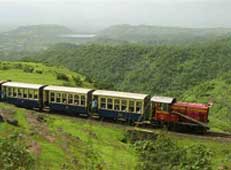
Neral to Matheran: Matheran Light Railway - Lovingly
known as "Toy Train" by the locals plies on the Neral - Matheran
route and stops at 3 stations - Juma Patti Station and Water
pipe Station [as the old steam engines used to be refilled here]
and Aman Lodge Station. This Matheran Light Railway started
operations in March 1907 and cost Rs.16 Lacs to build, so completed
100 years in 2007, and it is also on the tentative United Nations
Educational, Scientific and Cultural Organisation (UNESCO) heritage
list. By the time you are reading this, it may have already
got this status.
A German built Matheran Locomotive MLR 740 steam engine (website:
www.mlr740.co.uk), is now owned by the TRANSECO CENTRE which
is based in Peterborough (UK). Four of these steam locomotives
were imported from Germany by the Peerbhoy family (Sir Adamjee
Peerbhoy), who were from the local Bohra business community.
One is still operating in the UK, another is operating in Darjeeling.
Then, there are two more, one at the Matheran station as a permanent
exhibit, the fourth is at the National Railway Museum in New
Delhi.
Other travel options: There is a share-a-taxi service from Neral
town to Dasturi Naka in Matheran. There is also a mini bus service
by Maharashtra State Road Transport Corporation (MSRTC), between
Karjat and Matheran, via Neral.
Travel By Road (Mumbai to Matheran): Mumbai and Pune
are two Major cities connected to Matheran by Road. From Mumbai
you have to go to Navi Mumbai and then towards Panvel after
which you get on to the Mumbai Pune Expressway. 8 km ahead you
exit at the Shedung/ Khopoli turnoff and get onto the old Bombay
- Poona road. Then, after some time there will be a turnoff
on your left from a place called Chowk where the sign board
suggests you to turn left for Matheran. From Chowk to Karjat
rail crossing is 9 km, then 12 km to Neral. About 7 km is Dasturi
Naka (this is the last point till which cars are allowed), the
car park is here.
Pune to Matheran: Once you get onto the Pune Mumbai Expressway
at Pune you get off the Pune Mumbai Expressway at the Khopoli
exit after passing Lonavala/ Khandala and get on the old Poona
Bombay road. Around 18 km from there, you turn right at a place
called Chowk where the sign board suggests you to turn left
for Matheran. From Chowk to Karjat rail crossing is 9 km, then
12 km to Neral. About 7 km is Dasturi (this is the last point
till which cars are allowed), the car park is here.
AURANGABAD The
city of Aurangabad was founded by Malik Ambar, the Prime Minister
of Murtaza Nizam Shah II, in 1610, on the site of a village, Khirki.
When Fateh Khan, Malik Ambar's son succeeded the throne in 1626,
he named the city 'Fatehpur'. In 1653, when Aurangzeb became the
Viceroy of the Deccan, he made it his capital, and renamed it
Aurangabad. A region that has been inhabited since the Stone Ages,
Aurangabad has seen several dynasties come and go, absorbing the
culture of each into itself.Maurya rule heralded the advent of
Buddhism in the state of Maharashtra. The earliest caves at Ajanta
and Pithalkora were excavated in the 2nd century BC, during the
Satvahana era. Paithan, then known as Pratishthana, was an important
trade centre at the time. Buddhism flowered during the Chalukya
period, which consequently saw the mushrooming of many viharas
(monasteries), and chaityas (chapels), that were later excavated
at Aurangabad, Ajanta and Ellora. Later, the Rashtrakutas built
many temples, significantly, the Kailasa temple at Ellora, an
unparalleled piece of ancient Indian architecture. What
to see Aurangabad
Caves :
Just outside the city, lie the Aurangabad caves, excavated between
the 2nd and 6th century AD. Tantric influences can be discerned
in their architecture and iconography.There are twelve caves
in all, a major chunk of which are viharas, of which Caves 3
and 7, are the most fascinating. Cave 3 stands supported by
12 finely carved columns, and sports sculptures portraying scenes
from the Jataka tales. Cave 7 houses an imposing sculpture of
a Boddhisattva, praying for deliverance. Bibi
- Ka - Maqbara : The Bibi - Ka - Maqbara was built in 1679, by Aurangzeb's son, as a tribute
to his mother Begum Rabia Durani. A replica of the Taj Mahal,
this monument is the only specimen of Mughal architecture of
its kind, in the Deccan plateau. Pan
Chakki: Dating back to the 17th
century, this ingenious watermill, that takes its name from
the mill, which used to grind grain for the pilgrims, was designed
to generate energy via water, brought down from a spring on
a mountain, located nearby. The energy generated was, further,
used to turn the large grinding stones of the flour mill. It
was built by Malik Ambar himself, in 1695. In 1624, a Sufi saint
who was much revered by Aurangzeb was buried here, the gardens
and fish tanks serve as his memorial.
Top LONAVALA AND KHANDALA
Lonavala
and Khandala are two charming little hill stations, in Maharashtra,
located on the western slopes of the Sahyadri mountain range.
These are perched at an altitude of 625 m, and are five km apart.
Quite popular as health resorts, there are a number of sanatoria
dotting the hills, in both towns. Khandala is smaller and relatively
calmer of the two, though browsing through Lonavala's bazaar could
yield some wonderful surprises. Both these sites offer scenic
views of the surrounding hills, and in the monsoons, with myriad
waterfalls, it is sheer magic.
What
to see Karla,
about 12 km from Lonavala, is the site of the largest Chaitya
caves in India, built in 80 B.C. Among the best-preserved Buddhist
temples in India, they represent the zenith, in terms of purity
of design of this style of temple architecture. Taxis and autorickshaws,
easily available in Lonavala and Khandala, are the best ways of
getting to and from Karla.
Temperatures vary from 12 deg celsius to 36 deg celsius
throughout the year. October to May is the best time to visit.
Top
PUNE Pune,
located 170 kms. south of Mumbai has been the cultural capital
of Maharashtra, since ages. The city was one of the pivotal basesof
the 17th century great Maratha ruler Chhatrapati Shivaji, who
was born at the Shivneri Fort here.Pune became the seat of the
enterprising Peshwas, under whom Maratha power rose into a major
political force. The Peshwas were renowned patrons of the arts
and in their time, enriched the city with temples, gardens and
educational institutions.It was here that Lokmanya Bal Gangadhar
Tilak introduced the principle of Swadeshi during the Freedom
Movement. Today Pune is one of the leading metros in India, with
the Film and Television Institute of India and National Defence
Academy based here. It is fast becoming one of the major hubs
of industry and commerce in the country.
Top What
to see The
Aga Khan's Palace 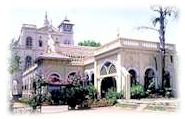 Kasturba
Gandhi Smriti Mandir - This beautiful building with salons and
suites, is a great historical landmark. It was here that Mahatma
Gandhi and other leaders of the Indian National Congress were
imprisoned during the 1942 Quit India Movement. Here lies the
samadhi of Kasturba Gandhi, the Mahatma's wife. Bund Gardens -
Presently known as Mahatma Gandhi Udyan, these gardens are situated
on the banks of Mula-Mutha River. The bund was constructed by
Sir Jamshedji Jeejeebhoy for providing water to the poor. Kasturba
Gandhi Smriti Mandir - This beautiful building with salons and
suites, is a great historical landmark. It was here that Mahatma
Gandhi and other leaders of the Indian National Congress were
imprisoned during the 1942 Quit India Movement. Here lies the
samadhi of Kasturba Gandhi, the Mahatma's wife. Bund Gardens -
Presently known as Mahatma Gandhi Udyan, these gardens are situated
on the banks of Mula-Mutha River. The bund was constructed by
Sir Jamshedji Jeejeebhoy for providing water to the poor.
National
Defense Academy -
Situated at Khadakvasla, 17 kms. from Pune, the Academy imparts
basic training to the cadets of all three branches of the services,
Army, Air Force and Navy.
Parvati Hill and Temples - The Parvati Temple was the erstwhile
private shrine of the Peshwa rulers. Now it is a popular tourist
spot, with the Parvati and Devdeveshwar temples standing atop
a hill and also the Parvati Museum which houses replicas of ancient
paintings, old manuscripts, weapons and coins.
Raja
Dinkar Kelkar Museum - This Rajasthani-style building
showcases a one-man collection of some of the most fascinating
Indian artifacts one can ever get to see. Among 36 sections full
of antiques, carved palace doors, miniatures, the 'Mastani Mahal'
is particularly famous. Mastani was the mistress of ‘Peshwa Bajirao’,
the Prime Minister of Satara. This impressive collection was donated
to the Govt of Maharashtra by Shri Dinkar Kelkar and is only displayed
by rotation Shaniwarwada 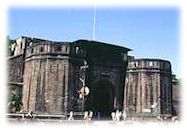 Built in 1736, this was once the palace of the Peshwa rulers.
After the palace was mysteriously destroyed by fire in 1827, only
an old fortified wall, the majestically built 'Nagarkhana' and
a lotus pool park remain.Wadas came into existence during the
reign of the Peshwas. Wada is an area enclosed by walls housing
several rooms to live in, courtyards and water tanks, and is almost
a small housing complex in itself. These Wadas served as the residence
of the Peshwas and Shaniwar Wada was one of them. In fact, Maratha
culture depicts this Wada as one of its important landmarks. Located
in Kasba Peth, the seven-storey-high Shaniwar Wada has now become
a picnic spot for the Puneites. Built in the year 1730 by the
first Bajirao Peshwa, the Wada has been a silent spectator to
the lives of the Peshwas. The magnificent Dilli Darwaza marks
the entrance of the Wada. The imposing facades and impregnable
fortifications are still so prominent that a person cannot have
doubts about the strength they once possessed. Visitors can still
walk along the castle ramparts and get the feel of the fort. The
exquisitely engraved arches, the splendid Ganesh Darwaza and the
impressively built Ganesh Rangmahal which became the hall of justice,
are definitely worth taking a look at. Built in 1736, this was once the palace of the Peshwa rulers.
After the palace was mysteriously destroyed by fire in 1827, only
an old fortified wall, the majestically built 'Nagarkhana' and
a lotus pool park remain.Wadas came into existence during the
reign of the Peshwas. Wada is an area enclosed by walls housing
several rooms to live in, courtyards and water tanks, and is almost
a small housing complex in itself. These Wadas served as the residence
of the Peshwas and Shaniwar Wada was one of them. In fact, Maratha
culture depicts this Wada as one of its important landmarks. Located
in Kasba Peth, the seven-storey-high Shaniwar Wada has now become
a picnic spot for the Puneites. Built in the year 1730 by the
first Bajirao Peshwa, the Wada has been a silent spectator to
the lives of the Peshwas. The magnificent Dilli Darwaza marks
the entrance of the Wada. The imposing facades and impregnable
fortifications are still so prominent that a person cannot have
doubts about the strength they once possessed. Visitors can still
walk along the castle ramparts and get the feel of the fort. The
exquisitely engraved arches, the splendid Ganesh Darwaza and the
impressively built Ganesh Rangmahal which became the hall of justice,
are definitely worth taking a look at.
Pataleshwar
Cave Temple-
Ensconced deep in the heart of the city, at Shivajinagar, is a
8th century rock-cut temple. Reminiscent of Ellora, the temple
has been painstakingly hewn from a single rock and houses massive
pillars, a Shiva shrine and a Nandi bull. Saras Baug - With pleasant
lawns and the famous Ganesh temple built by Madhavrao Peshwa,
Saras Baug is a popular evening spot at Pune. Shinde's
Chhatri - Among the best architectural
sights in Pune, this memorial of the great Maratha warrior, Mahadaji
Shinde, houses his Chhattri (umbrella) and his portrait in silver.
Lal
Deval (Synagogue) -
A red brick and trap stone building of English-Gothic style, the
Lal Deval was built by the famous David Sassoon in 1867.
Pashan
Lake - 12 kms.
north of NDA, this beautiful lake is a home to a variety of migratory
and residential birds. The
Film and Television Institute of India (FTII)
- A premier institute, FTII imparts training
in all major branches of film training in all major branches of
film making and is known to have produced some of the finest film
professionals of the country. University
Buildings 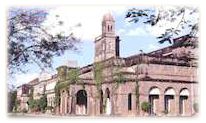 The
site of the Pune University, the stately mansion at Ganeshkhind,
was the official residence of the Governor of Mumbai during the
monsoon season. A large building in Italian-Gothic style built
with the local grey trap rock, it is surrounded by a high square
tower (30 metres high), a swimming pool and well kept lawns. The
site of the Pune University, the stately mansion at Ganeshkhind,
was the official residence of the Governor of Mumbai during the
monsoon season. A large building in Italian-Gothic style built
with the local grey trap rock, it is surrounded by a high square
tower (30 metres high), a swimming pool and well kept lawns.
Yoga
Institute - The ‘Ramamani Iyengar Memorial Yoga Institute’ directed by Mr
B K S Iyengar is an internationally reputed Yoga institution.
Courses for short and long durations are conducted here, depending
on individual requirements and the availability of time.
Sinhagad
Pune 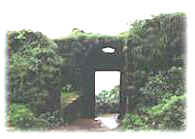 Sinhagad stands at a height of 1290 metres, 25 kms away from the city.
Over 300 years ago, Tanaji, the Maratha warrior, and his army,
with the help of ropes and giant lizards (ghorpuds), scaled the
sheer precipice and silently stormed the Bijapur citadel at midnight,
creating history. The Samadhi to Tanaji Malusare stands as a reminder
of the bravery and glorious victory of the Marathas. On hearing
of the passing away of Tanaji, Shivaji is known to have said, "We have gained the fort but lost the lion". So the fort got its
name ‘Sinha (lion) gad (fort). Sinhagad stands at a height of 1290 metres, 25 kms away from the city.
Over 300 years ago, Tanaji, the Maratha warrior, and his army,
with the help of ropes and giant lizards (ghorpuds), scaled the
sheer precipice and silently stormed the Bijapur citadel at midnight,
creating history. The Samadhi to Tanaji Malusare stands as a reminder
of the bravery and glorious victory of the Marathas. On hearing
of the passing away of Tanaji, Shivaji is known to have said, "We have gained the fort but lost the lion". So the fort got its
name ‘Sinha (lion) gad (fort).
Top Around
Pune Caves
- Karla and Bhaja About
50-60 kms. away from Pune, these rock-cut Buddhist caves date
back to 1st and 2nd century B.C. These caves consist of several
Viharas (dwelling caves) and Chaityas (chapels) of the Buddhist
monks. Forts Lohagad
and Visapur - 52 kms. away from Pune,
atop an impressive hill, these majestic forts were built in the
18th century. They are separated by a 1 km. ridge and are ideal
for trekking. Shivneri
- 94.5 kms. away from Pune, is the magnificent Shivneri
fort where Shivaji was born. One of the interesting features of
this fort is a mosque with two minarets which are joined by a
graceful arch. Sinhagad
- Named after the lion-hearted
general of Shivaji - Tanaji Malusare, this awesome Fortress of
the Lion stands at a height of 1290 metres, 25 kms. away from the city. Over
300 years ago, Tanaji, the Maratha warrior, and his army, with
the help of ropes and giant lizards (ghorpuds), scaled the sheer
precipice and silently stormed the Bijapur citadel at midnight,
creating history.
The ‘samadhi’ to Tanaji Malusare stands as a reminder of the bravery
and glorious victory of the Marathas. On hearing of the passing
away of Tanaji, Shivaji is believed to have said "We have gained
the fort but lost the lion". Whereupon the fort got its name ‘Sinha
(lion) gad (fort)’. Temples Dehu
- Alandi -
Dehu was the birthplace of the greatest Marathi Saint of the 17th
century - Tukaram. It is situated on the banks of the river Indrayani.
Another pilgrim centre, 22 kms. away from Pune is Alandi, where
the 'Samadhi' of the famous saint-poet Dnyaneshwar is situated.
Bhimashankar
- 122 kms. from Pune, is the
elaborately carved Shiva temple, one of the 12 Jyotirlingas of
the country. A fair is held here annually during Mahashivratri.
Jejuri
- Jejuri is known for the
famous temple of 'Khandoba' and an annual fair held here is attended
by Hindus in large numbers. Water
Sport Complex - Panshet - Recently developed
by MTDC, Panshet water-sports complex offers sheer fun and enjoyment
to the visitor. Speed boats, water scooters, kayaking windsurfing...
the resort is packed with various thrilling water-sports.
Top AJANTA CAVES 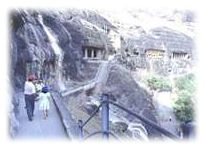 It
was only in the 19th century, that the Ajanta group of caves,
lying deep within the Sahyadri hills, cut into the curved mountain
side, above the Waghora river, were discovered. A group of British
officers on a tiger hunt, stumbled on these ancient works of art.
They depict the story of Buddhism, spanning the period from 200
BC to 650 AD. It
was only in the 19th century, that the Ajanta group of caves,
lying deep within the Sahyadri hills, cut into the curved mountain
side, above the Waghora river, were discovered. A group of British
officers on a tiger hunt, stumbled on these ancient works of art.
They depict the story of Buddhism, spanning the period from 200
BC to 650 AD.
The
29 caves were built as secluded retreats of the Buddhist monks,
who taught and performed rituals in the Chaityas and Viharas,
the ancient seats of learning, and nerve - centres of the Buddhist
cultural movement. Using simple tools like hammer and chisel,
the monks carved out the impressive figures adorning the walls
of these structures. Exquisite wall - paintings and sculptures
speak volumes of the India of yore. Many of the caves house panels
depicting stories from the Jatakas, a rich mine of tales of the
several incarnations of the Buddha. Images of nymphs and princesses
amongst others, are also elaborately portrayed. Cave 1 houses
some of the most well - preserved wall paintings which include
two great Boddhisattvas, Padmapani and Avalokiteshvara. Caves
2 , 16 and 17 also contain amazing paintings, while Caves 1, 4,
17, 19, 24 and 26 boast of some of the most divine sculptures.
The flying apsara, of Cave 17, and the image of Buddha preaching
in Cave 17, are a couple of unforgettable works of art. The Ajanta
caves and the treasures they house, are a landmark in the overall
development of Buddhism as such.
Top ELLORA 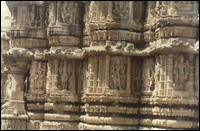
The
Ellora caves, 34 in number, are carved into the sides of a basaltic
hill, 30 kms from Aurangabad. The finest specimens of cave - temple
architecture, they house elaborate facades and exquisitely adorned
interiors. These structures representing the three faiths of Hinduism,
Buddhism and Jainism, were carved during the 350 AD to 700 AD
period. The 12 caves to the south are Buddhist, the 17 in the
centre dedicated to Hinduism, and the 5 caves to the north are
Jain.
The sculpture in the Buddhist caves accurately convey the nobility,
grace and serenity inherent in the Buddha. Caves 6 and 10 house
images from the Buddhist and Hindu faith, under the same roof,
the latter dedicated to Vishwakarma, the patron saint of Indian
craftsmen. The Vishvakarma cave is both a Chaitya and a Vihara,
with a seated Buddha placed in the stupa. Its two - storeyed structure
sports a colourful pageant of dwarfs, dancing and making music.
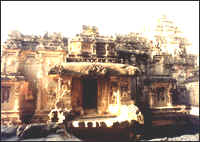
The Kailasa temple in Cave 16 is an architectural wonder, the
entire structure having been carved out of a monolith, the process
taking over a century to finish. This mountain - abode of Lord
Shiva, is in all probability, the world's largest monolith, the
gateway, pavilion, assembly hall, sanctum and tower, all hewn
out of a single rock. What is amazing about it is the fact, that
unlike other temple structures which are built base onwards, the
sculptor or architect involved here, started carving from the
very top and the sides. Gigantic, though it is, it remains one
of the most delicate and intricate ancient works of art. The Dumar
Lena cave resembles the famous cave - temple at Elephanta, and
is dedicated to Lord Shiva.
The Jain caves are about a mile away from the Kailasa temple,
amongst which Cave 32, houses a beautiful shrine adorned with
fine carvings of a lotus flower on the roof, and a yakshi on a
lion under a mango - tree, while Caves 32 and 34 contain grand
statues of Parasnath. The other Jain caves sport the images of
Tirthankaras, and one of them, also, has a seated figure of Mahavira.
These cave shrines are memorable for their invaluable contribution
to the enormous wealth of Indian heritage.
City
Helpline
| Railways |
Airlines |
Hospitals |
General
Enquiry Tel-131,626575
Reservation Enquiry
Tel- 132,636666
Arrival/ Departure (recorded)
Tel-133
|
Indian
Airlines
Tel- 140/141
Reservation Tel-142,143
City Office Tel- 626451,624225
Airport Tel- 689433
Jet Airways
City Office Tel- 637181
Airport Tel-685591/92/93
|
K.E.M.
Hospital
Tel- 625600/ 625601
Poona Hospital
Tel- 431706/431707
Joshi Hospital
Tel- 373144/ 377463
Lok Manya Hospital
Tel- 756496 /756497 |
Top |
|