|
|
|
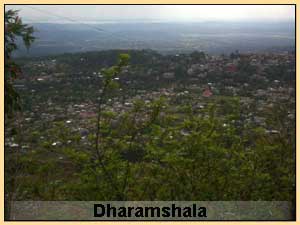
Dharamshala: Dharamshala recognised as headquarters of Kangra District in 1855. Lying on Dhauladhar spur, from a war memorial monument at 1300 meters, to Mcleodganjat an altitude of 1770 meters spread over an 8 kilometer rising slope the place has a distinct character. It has Una district on the South-West, Gurdaspur district of Punjab on the North-West, Lahaul-Spiti and Chamba districts on the North,Kullu and Mandi districts on the East, and South touches Hamirpur district. |
|
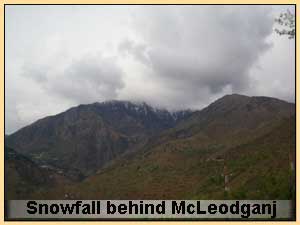
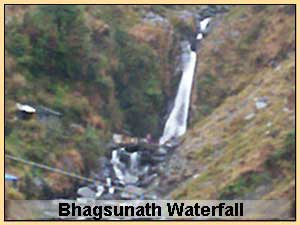
Dharamsala stands at the foot of Dhauladhar and has a magnificent view of snowy peaks, deodar and pine forests, tea gardens and beautiful hills. The snow line is perhaps more easily accessible at Dharamsala than any other hill station in India. Dharamsala now really has become international, with a number of Tibetan settlements and the residence of Noble Laureate the ‘Dalai Lama'. Dharamsala is divided into two distinct parts : lower Dharamsala the civil and business area with Courts and Kotwali bazaar and upper Dharamsala composed of places like Mcleod Ganj and Forsyth Ganj. Dharamsala is easily accessible from Delhi, Punjab and Chandigarh and from other important places of Himachal. Tourism in Dharamsala offers two very beautiful lakes around Dharamsala i.e. Dal Lake and Kareri Lake.Tourism in Dharamsala offers some very beautiful place to explore around i.e. War Memorial, Mcleodganj, Bhagsunag Fall, St. John's Church in the wilderness, Dharamkot, Triund and Naddi. All these places greets the tourists with refreshing winds and offer a memorable experience. There is a wildlife sanctuary named Pong Lake Sanctuary near Dharamsala and a mini zoo named Gopalpur Zoo near Dharamsala. |
|
Dharamshala |
| Places to be visited |
|
| War Memorial |
Kangra Art Museum |
|
|
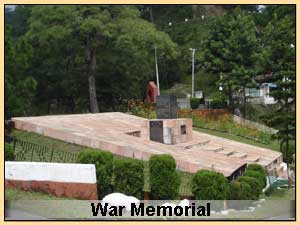
Commemorates many brave solidersfrom the region who laid their lives in various wars. |
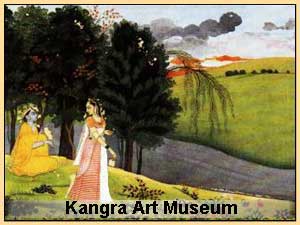
Specimens of world famed Kangra miniature
paintings. The museum runs an art school where techniques of traditional,
painting are taught. |
McLeodganj |
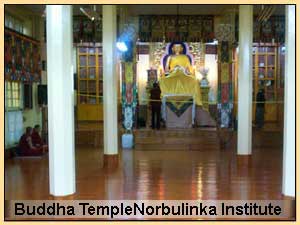
Norbulinka Institute |
|
|
| |
Rose to prominence when his holinessthe Dalai Lama Spiritual leadrer of the Tibetans made it his refuge after leaving Tibet. Nicknamed “Little Lhasa” traditional Tibetan medicine and handicraft here are great attractions. |
|
|
Named after a summer residence of Dalai Lama at
Lhasa, this institute is instrumental in reservingand propogating Tibetan
art and culture |
|
|
|
Namgyal Monastery - has larger than life statues of Buddha, Avloketshwara and Padmasambava. |
|
Church of St. John in the wilderness – is a drssed stone church in
whose courtyard lies the grave of lord Elgin, a former British Viceroy who
died at Daramshala in 1863. |
|
Dal Lake – a small scenic lake surrounded by Deodar trees with a temple of Durgeshwara Mahadev by the lakeside.
Dharamkot - Wooded picnic spot.
Triund - Sheer altitude from here offers a commanding view of the valley and snow – clad mountains. It is base for several Trekking routes.
|
|
|
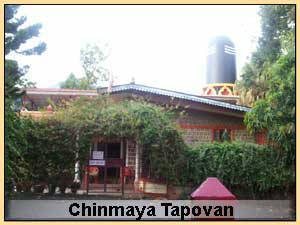
Chinmaya Tapovan |
|
|
|
(10 Km) was established by the late Swami Chinmayananda as a meditation, health and recreation centre. |
|
|
TEMPLES TO BE VISITED |
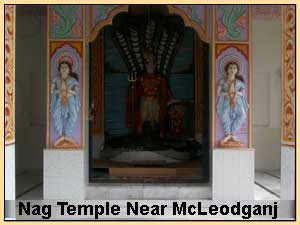
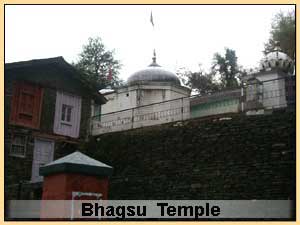
Bhagsu-Nag Temple (11 Km) |
Besides a fresh water spring lies a temple of Bhagsu-Nag. There was a severe drought in the capital during the kingdom of Raja Bhagsu. The local chiefs requested the king to do something or else the people would leave his kingdom. The king promised to do something and set out himself in search of water. After 3 days of searching he reached the Sacred Nag Dal (Lake) at a height of 18000 ft.
This lake was very big and had a lot of water. Raja Bhagsu used trickery to fill the water of the lake into a small vessel. He decided to spend the night there, as it had grown dark. Later in the Evening Nag the Lord of Snakes happened to pass by the lake and was shocked to find the lake empty. He followed the footsteps and reached where Raja Bhagsu was resting. He challenged Bhagsu for a duel and defeated him in the ensuing fight. The moment the vessel containing the sacred water fell on the ground water started flowing from there. Badly injured Raja Bhagsu prayed to Nag and moved by his prayers Nag granted him a boon that this place shall henceforth be referred firstly by the kings name and then by the Lords name and he shall become popular.
Henceforth this place came to be known as "BhagsuNag". In the Beginning of the Kalyug Raja Dharamchand dreamt that lord Shiva asked him to build a temple here to bring prosperity to the area. Today it is about 5100 years since this temple was built.
|
|
|
|
|
Chamunda Devi : (15 Km) is an ancient temple on a vantage point that
provides a panoramic view of Chamba town.
|
| KANGRA |
Places to be visited
Masroor Temple : (40 Km) is the only rock cut temple up north of Vindaya
ranges in central India. Scale and stone craft of this monument dedicated
to Ram, Laxman and Sita, sparks admiration.
Trilokpur : (41 Km) has a cave temple with astounding stalactite and
stalagmite formations dedicated to Lord Shiva.
Nurpur : (66 Km) has remains of a old fort and temples.
Maharana Pratap Sarovar (Pong Dam 55 km) – is a reservoir where
fishingand water sports facilities are available. Thousands of migratory
birds descend upon this water body each winter and avifauna lovers from
the world over throng to watch them. Water sports Regatta in the month of
January is an event not to be missed
Haripur : (55 Km) is an isolated place which remnants of old temples.
Garli : (4 Km from Pragpur) has oldhouses with interesting architechture. |
|
| Places to be visited |
Neugal Khad : a Scenic Spot with acres of Tea gardens around.
Agriculture University : is a well laid out campus with vast open spaces that provides research backup to the farming community.
Gopalpur : Small Zoo of Himalayan Birds.
Andretta : is a scenic village that famous playwright Norah Richards and artist Shobha Singh. At small open air theatre plays are still performed each summer to commemorate orah Richard’s contribution to dramatics. Shoba Singh’shouse has been converted into an art Gallery where the famous artist works are on permanent display.
Al Hilal - Land of Crescent Moon known as Taragarh Palace.
Tashijong ( Tibetan Monastery )
Baijnath Temple : (15 Km) harbours an exquisite specimen of the thirteenth century temple architechturein finely chiselled stone. Dedicated of Lord Shiva.
Mahakaal Temple: (22 Km) is considered to be only one of two temples dedicated to Lord Shiva as Mahakal in the country.
Bir : Tibetan Monastery amidst a tea plantation countryside.
Floriculture
Kaya Kalp |
|
|
JOGINDERNAGAR |
| Places to be visited |
Haulage : Thrilling Ride from Jogindernagar to Barot.
Macchyal Lake : enchanting lake makes foran ideal outdoor excursions.
Bassi Power House : Picnic Spot.
Herbal Museum : Herbal garden attached to the museum.
Jhatingri : thick deodar forests.
Barot : is an off- beat river side camping spot. |
JWALAMUKHI |
| Places to be visited |
Ashtabhuja
Raghunathji
Nagni mata
Chaumukha
Panj Teerthi
Mahakaleshwar
Baglamata |
| DEOTHSIDH |
| Places to be visited |
Famous Shaktipeeth Pilgrimage Circuit. |
Chintpurni Temple.
Brajeshwariji.
Jwalamukhji. |
| CHAMBA |
| Places to be visited |
Chowgan : a grassy lawn for the cultural activities
Saho : Has a temple glorifying Lord Shiva as “ Chandra Shekhra “ the moon god.
Chatrari : Woodwork craftmanship and superb 8th century metallic idol.
Bhuri Singh Museum : named after a formerruler of Chamba displays rare artefacts that reflect Chamba’s rich cultural heritage. It houses a fine collection of miniature paintings from Kangra, Basholi, Chamba and other pahari schools.
Hari Rai Temple : is renowned for its finely executed classical forms. It has six main shikhar style temples and several smaller shrinesconstructed during the 10th century, dedicated to Lord Vishnu has idols of Ganeshaand Buddha on its two sides
The Laxmi Narayan Temple : is renowned for its finely executed classical forms. It hassix main shikhar style temples and several smaller shrines constructed during the 10th century, dedicated to Lord Vishnu has idiols ganesha and buddha on its two sides.
Bharmaur : it centres around chaurasia – a temple sqare which owes its name to 84 shrines.
Manimahesh : is a pristine mountain lake.
Pangi Valley: is a high altitude remote valley sheltered between the Pir Panjal and Greater Himalayan Ranges. |
|
DALHOUSIE |
| Places to be visited |
Churches : Dalhousie has four of them. St.John’s is the oldest built in 1863, St.Francis was built in 1894, St.Andrew in 1903 and St.Patrick in 1909.
Satdhara : known for the medicinal properties.
Panjpulla : water falls from the natural soures flows under five bridges.
Bara Patthar : amidst thick woods is small temple of Bhulwani Mata in the village of ahla on the way to kalatope.
Kalatope : a picnic spot on the periphery of a wildlife sanctuary.
Subhash Baoli : a nice secluded place where Netaji Subhash Chandra bose spent a large portion of 1937 contemplating India struggle for freedom.
Bakrota Hills ; offers magnificent view of snow clad peaks. |
| |
|
|
|